
04 May, 2026
Open-source, 3D-printed platform enables low-cost, standardised electrocatalytic research
At just AUD$2.00, an accessible open-source, 3D-printed gas diffusion electrode or membrane electrode assembly could provide the answer to calls for standardisation of candidate catalyst testing.
A problem for researchers has been a lack of an agreed upon standard gas diffusion electrode reactor to enable robust comparison of catalytic reactions. Instead, the common practice is to compare the performance of a new catalyst for a particular reaction against that of a ‘standard’ or benchmark catalyst, within the same reactor. This practice reveals a further problem when no standard catalyst exists for a reaction, which typically applies for most reactions. In other words, researchers lack a platform to compare reaction processes.
Ideally, a new catalyst is compared to a standard catalyst (if it exists), and in a reproducible reactor.
To fix this, a University of Sydney based team with the ARC Centre of Excellence for Carbon Science and Innovation developed an accessible, affordable and adaptable 3D-printed gas diffusion electrode/membrane electrode assembly test reactor: ‘openGDE’ or *‘bayadjamara’.
Open source, inexpensive and easy to print
“We provide the design files and detailed instructions on how to modify and print the reactor platform, suitable for even a relatively novice operator,” says Research Fellow and developer of the platform, Dr Christopher Barnett.
The design allows for easy fabrication of multiple reactors, which drastically lowers the cost of gas diffusion electrode/membrane test reactors and allows for parallel testing.
“The open-GDE/bayadjamara platform enables anyone with a 3D printer to make the reactor for approximately AUD$2,” says Dr Barnett.
The research is published in the Australian Journal of Chemistry.
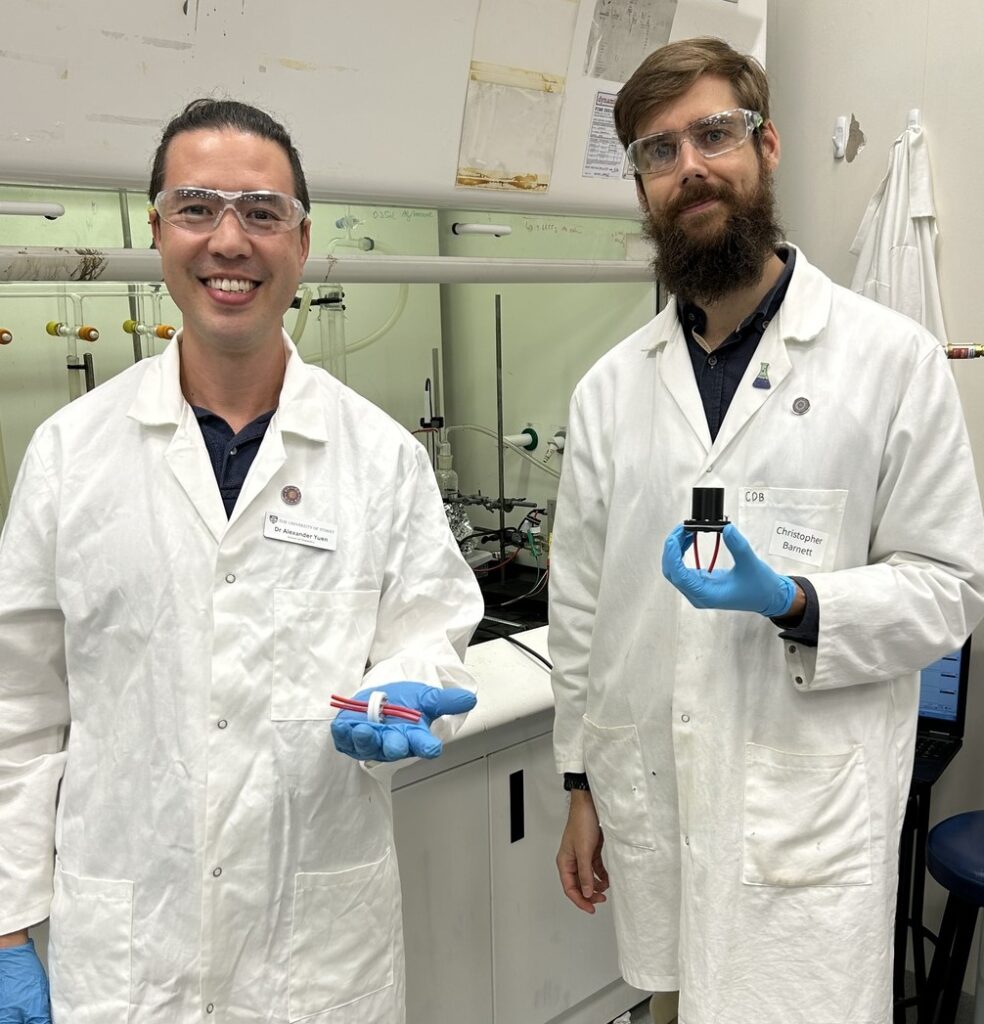
Bayadjamara capability
Beyond simple water splitting, the researchers demonstrate that open-GDE is suitable for a range of aqueous electrolytes, from highly acidic (1 M of HCl, pH = 0), to neutral (1 M of NaCl, pH = 7), to basic (1 M of NaOH, pH = 14). The reactors did not crack or leak during testing, and the self-supported catalyst discs remained intact.
“We would like to give all interested a low-cost, reliable way to compare data across labs. Open source is our philosophy to enable this,” says Centre Chief Investigator, Dr Alexander Yuen.
“To our knowledge, this is the first reported 3D-printed reactor platform that provides all source files on Github and Zenodo,” he says.
“We invite researchers to contact us to organise an exploratory kit provided at cost. The design files are available for use and modification under an open-source licence to encourage their adoption and adaptation by the research community,” says Dr Barnett.
“The provision of the open-source licence means that we also encourage researchers to experiment with the designs. We encourage all potential users to consider what is required for their particular research and to innovate and share accordingly,” says Dr Yuen.
*bayadjamara is the Australian First Nations’ Gadi language name for this project and means ‘air maker’.
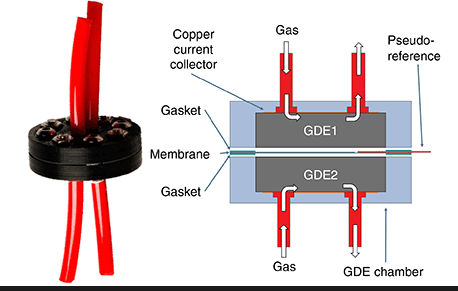 Figure 1. Left: image of example GDE|GDE reactor, using default settings (e.g. GDE 1 cm2). Right: simplified schematic of the reactor design.
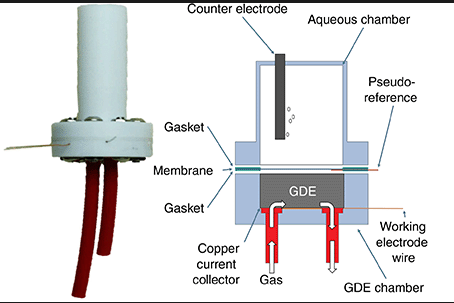 Figure 2. Left: image of an example GDE|Aq reactor, using default settings (e.g. GDE 1 cm2). Right: simplified schematic of the reactor design.
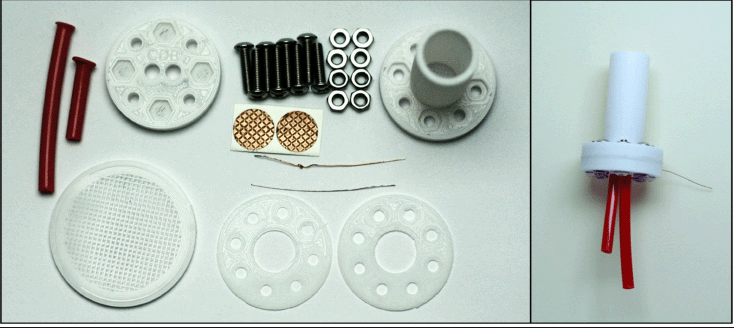 Left: expanded view of components in a simple GDE|Aq reactor setup. Top left-to-right: Two T-shaped tubes, GDE component, eight M3 × 12 bolts, eight M3 nuts, Aq component. Middle: two copper tape discs, one enamel copper wire with knot, one Ag/AgCl wire as reference electrode. Bottom left-to-right: Membrane holder, two TPE gaskets. Right: assembled GDE|Aq reactor.